Accompanying the development of Hanoi University of Civil Engineering (HUCE), the Faculty of Construction Economics and Management is one of the earliest-established faculties of the university. To meet the demand for qualified engineers and experts serving the national reconstruction and development, in 1963, the first cohort of students majoring in Construction Economics was admitted under the Faculty of Economic Engineering of Hanoi University of Science and Technology.
After five years of continuous improvement in teaching capacity, the Rector of Hanoi University of Civil Engineering decided to establish the Faculty of Construction Economic Engineering in Mao Trung village, Phuong Mao commune, Que Vo district, Ha Bac province (now Bac Ninh province), consisting of three departments: the Department of Construction Economics, the Department of Business Economics, and the Department of Planning and Organization.
This marked the establishment of the first independent Faculty of Construction Economic Engineering in Vietnam, providing formal and systematic training. Throughout the ups and downs of history, after several relocations and name changes, the growth and success of today’s HUCE have been significantly contributed to by the Faculty of Construction Economics and Management.
Since then, the Faculty has continuously developed its education and training activities at both undergraduate and postgraduate levels in various majors. Thousands of graduates have been equipped with professional knowledge and skills to work effectively in the construction industry, contributing to the nation’s sustainable development.
Today, the Faculty of Construction Economics and Management is one of the largest faculties of HUCE, attracting a high number of undergraduate, master’s, and doctoral students.
To align with the university’s development strategy and future orientation, the Faculty has officially issued its Mission, Vision, and Strategic Directions as follows:
“To educate high-quality human resources in construction economics and management; conduct scientific research; apply and transfer technology; and contribute to the sustainable development of Vietnam’s construction industry.”
“To become a leading education and research academic unit in Vietnam in the field of construction economics and management, recognised by organisations and enterprises for the quality of its education, research and innovation, and making an active contribution to the sustainable development of the construction industry and the nation.”
To realise its mission and vision, during the 2025–2030 term the Faculty will focus on the following strategies:
Quality assurance and programme updating: Every two years, the Faculty reviews and updates the learning outcomes of its academic programmes. Programme learning outcomes and curricula are continuously updated towards international integration, responsiveness to actual market needs, and alignment with development trends in the construction industry. Over the next five years, the Faculty will seek accreditation for all undergraduate programmes and progress towards accreditation of two master’s programmes.
Multidisciplinary education: Integrate economics and management knowledge with specialised construction knowledge to develop graduates capable of solving complex industry problems. The Faculty plans to expand its educational scale by opening two undergraduate programmes in “Asset Management” and a postgraduate programme in “Construction Investment Auditing”.
Faculty development: Strengthen the education and professional development of lecturers, while encouraging scientific research and innovation in teaching methods. Continue staff development and recruitment in line with plans to open new fields and majors. Over the next five years, the Faculty aims for 70% of lecturers to hold doctoral degrees and more than 15% to hold the title of professor or associate professor.
Developing a modern learning environment: Invest in modern facilities and equipment to provide favourable conditions for student learning and research.
Strengthening applied research: Focus on highly applicable research that addresses practical problems in the construction industry. Continue undertaking research projects at different levels (national, ministerial/provincial, and key university level), targeting three to five projects per year.
Research collaboration and international publication: Encourage collaborative research with leading universities and research institutes worldwide and in the region. Aim to publish eight to ten papers per year in reputable international journals indexed in ISI/Scopus.
Technology transfer: Establish channels for transferring research outcomes into production and business management practice.
Cooperation with enterprises: Strengthen collaboration with construction organisations and enterprises to create internship, research and employment opportunities for students. Each year, the Faculty will establish partnerships and sign memoranda of understanding with two to three enterprises or organisations.
Cooperation with state regulatory authorities: Contribute to the development of construction policies and legislation through quarterly professional seminars. Invite experts from state regulatory authorities to collaborate annually in the Faculty’s educational activities.
International cooperation: Expand educational and research cooperation with international universities and organisations in the construction field. Each year, the Faculty will invite experts from reputable universities worldwide for academic exchange and research collaboration.
Developing a professional image: Build a professional, dynamic and creative image through communication activities.
Organising scientific events: Organise scientific seminars and conferences to showcase the Faculty’s achievements and strengthen engagement with the community.
Developing research products: Develop commercially valuable research products to generate income for the Faculty.
The mission and vision of the Faculty of Economics and Construction Management have been formulated to align with, inherit and concretise the mission and vision of Hanoi University of Civil Engineering, thereby ensuring consistency with the University’s overall development direction. The Faculty’s mission, vision and strategy are periodically reviewed and updated on a five-year cycle in coordination with HUCE’s strategic plan. The development strategy of the Faculty of Economics and Construction Management is formulated in a specific, detailed and clearly quantified manner, providing a sound foundation for developing and implementing KPI indicators to evaluate strategy implementation effectively and transparently.
The Faculty of Construction Economics and Management aligns all its training and research activities with the Educational Philosophy Declaration of Hanoi University of Civil Engineering, issued under Resolution No. 34/NQ-HĐTĐHXDHN dated September 30, 2025:
"IDENTITY – HOLISTIC – EMPOWERMENT"
With nearly 70 years of development as a national key university in construction and architecture, HUCE’s identity serves as the foundation for asserting its position, preserving tradition, and reinforcing its institutional brand.
HUCE’s identity is rooted in:
In the context of globalization and sustainable development, society needs graduates who are not only professionally competent but also ethical, responsible, adaptive, and capable of leadership.
Holistic education at HUCE encompasses:
In the age of globalization and Industry 4.0, empowering education provides the foundation for independent thinking, adaptability, lifelong learning, and creative innovation.
HUCE’s educational philosophy embraces liberty in learning and empowerment in action, nurturing free minds and capable citizens.
Empowerment at HUCE emphasizes:

 /
/



 30/09/2026
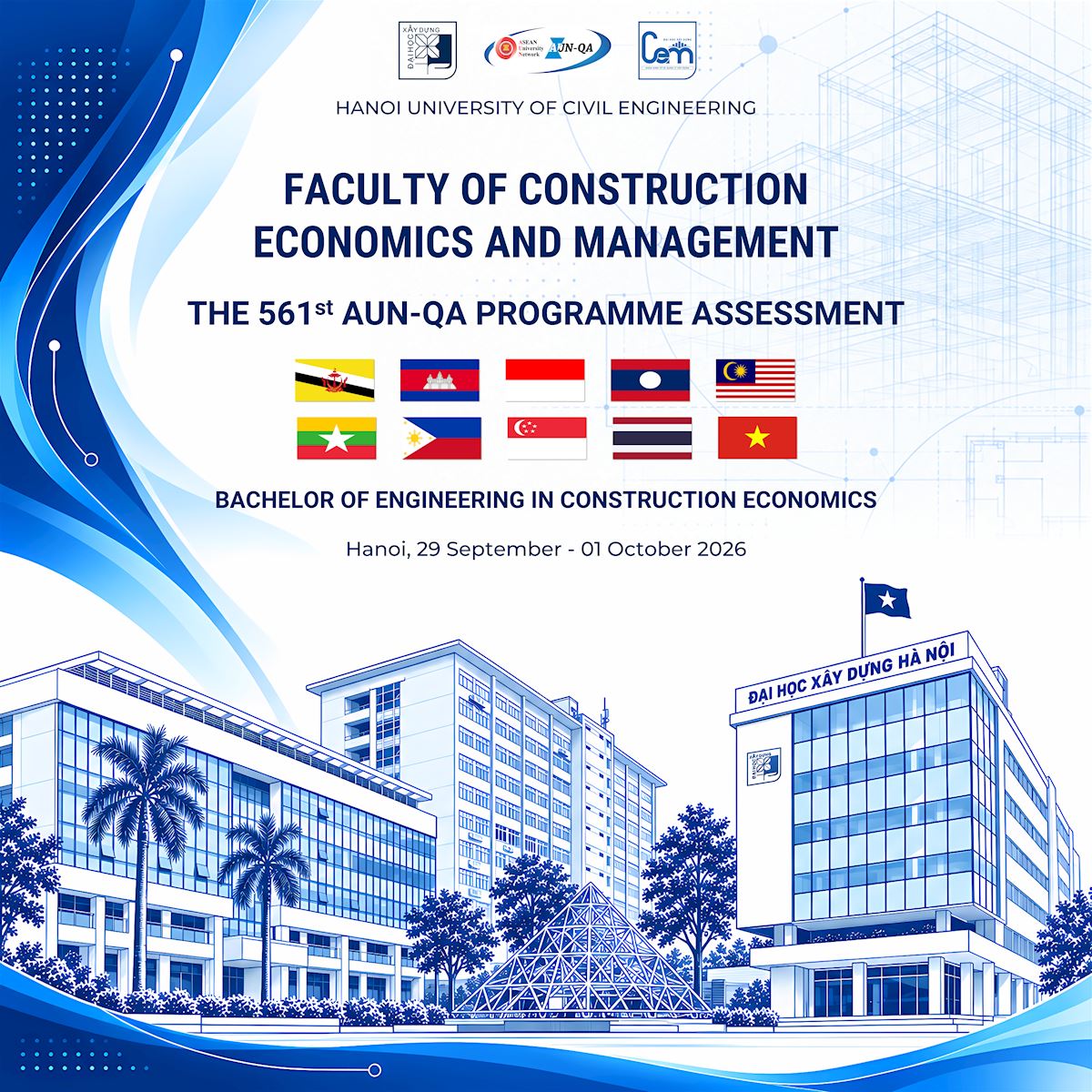
 ![[CONSTRUCTION ECONOMICS ENGINEERING PROGRAMME – OVER 60 YEARS OF DEVELOPMENT, WORKING TOWARDS AUN-QA QUALITY STANDARDS]](https://kinhtexaydung-en.huce.edu.vn/images57/Images/CEM/Picture1(1).png)