FACULTY OF CONSTRUCTION ECONOMICS AND MANAGEMENT
In 1963, the Construction Economics major was established within the Faculty of Economic Engineering at Hanoi University of Science and Technology. In 1965, the Department of Construction Economics and Organization was officially founded.
On August 8, 1966, when the Faculty of Civil Engineering separated from Hanoi University of Science and Technology to form Hanoi University of Civil Engineering (HUCE), the Department of Construction Economics and Organization was also transferred to become part of the new university.
In July 1967, the Department of Construction Economics and Organization separated from the Faculty of Civil Engineering and, together with the part-time training division of HUCE, formed the Faculty of Economics – Part-time Education. By the end of 1968, the Faculty of Construction Economics Engineering was officially established in Mao Trung Village, Phuong Mao Commune, Que Vo District, Ha Bac Province (now Bac Ninh Province). The faculty comprised three departments: Construction Economics, Business Economics, and Organization – Planning.
Since its establishment, the Faculty has undergone several name changes to suit different historical contexts:
Faculty of Construction Economics Engineering (1968 – 1986)
Faculty of Construction Economics and Business Administration (1986 – 1991)
Faculty of Construction Economics (1991 – 2008)
Faculty of Construction Economics and Management (April 2008 – present)
The Faculty of Construction Economics and Management, Hanoi University of Civil Engineering, has continually developed and expanded. It currently has 64 staff members and lecturers, including 02 People’s Teachers, 03 Meritorious Teachers, 03 Professors, 07 Associate Professors, 01 Doctor of Science, 26 PhDs, 10 Senior Lecturers, and 32 Masters.
Many lecturers have been trained abroad—in countries such as the UK, Australia, France, and Germany—and possess extensive teaching experience, professional expertise, and high credibility in the field of construction investment.
Dean: Assoc. Prof. Dr. Nguyen Quoc Toan
Academic Divisions:
Department of Construction Enterprise Economics
Department of Construction Economics
Department of Real Estate Economics and Management
Department of Project Management and Law
Department of Planning and Organization
Institute of Investment and Construction Management
Graduates from the Faculty of Construction Economics and Management are equipped with in-depth knowledge and professional skills to undertake various tasks related to construction, construction economics, and construction management (including urban management and development, real estate business and management, and investment management).
They can work in both domestic and international organizations, such as governmental agencies, research and training institutions, financial organizations, and enterprises.
The Faculty aims to educate construction economics and management engineers with strong political awareness, ethics, health, teamwork ability, and professional competence to perform effectively in:
construction investment activities,
urban management and development, and
real estate investment and business.
Students are equipped with three main areas of specialized knowledge:
Technical and Construction Technology Knowledge
Economic and Investment Knowledge (in both construction and real estate business)
Construction and Real Estate Management Knowledge
These integrated knowledge areas ensure that graduates are well-qualified for professional positions and are highly sought after by employers. Furthermore, the comprehensive training enables them to adapt to different career fields or start their own businesses.
The Faculty currently offers three undergraduate majors:
Construction Economics
Construction Economics (KT)
Construction Economics (English Program – KTE)
Construction Management, with three specializations:
Urban Economics and Management (QD)
Real Estate Economics and Management (BDS)
Construction Investment Auditing (KTDT)
Project Management
Project Management (QLDA)
The Faculty currently has approximately 3,500 students (about 700 students per cohort), making it one of the largest faculties at HUCE.
Notably, the English-taught Construction Economics Program (KTE) provides high-quality training entirely in English.
According to annual surveys, over 94% of graduates find employment immediately after graduation.
In addition, the Faculty is responsible for postgraduate training at the master’s level in Construction Management, with three specializations: Construction Economics, Urban Management, and Project Management. This is the largest postgraduate program at HUCE.
Training three undergraduate programs, including the English-taught Construction Economics Program (KTE);
Offering master’s programs in Construction Management (three specializations: Construction Economics, Urban Management, and Project Management);
Supervising doctoral training, with nearly 30 PhD candidates currently conducting research under the guidance of the Faculty’s academic staff;
Conducting scientific research projects at the university, ministerial, and national levels; mentoring students for national competitions and research awards;
Compiling and publishing textbooks, teaching materials, reference books, and technical standards;
Providing consultancy services, implementing construction projects, and collaborating on applied research with domestic and international organizations and enterprises;
Cooperating in scientific research, education, and human resource development with ministries, research institutes, and enterprises both in Vietnam and abroad.

 /
/

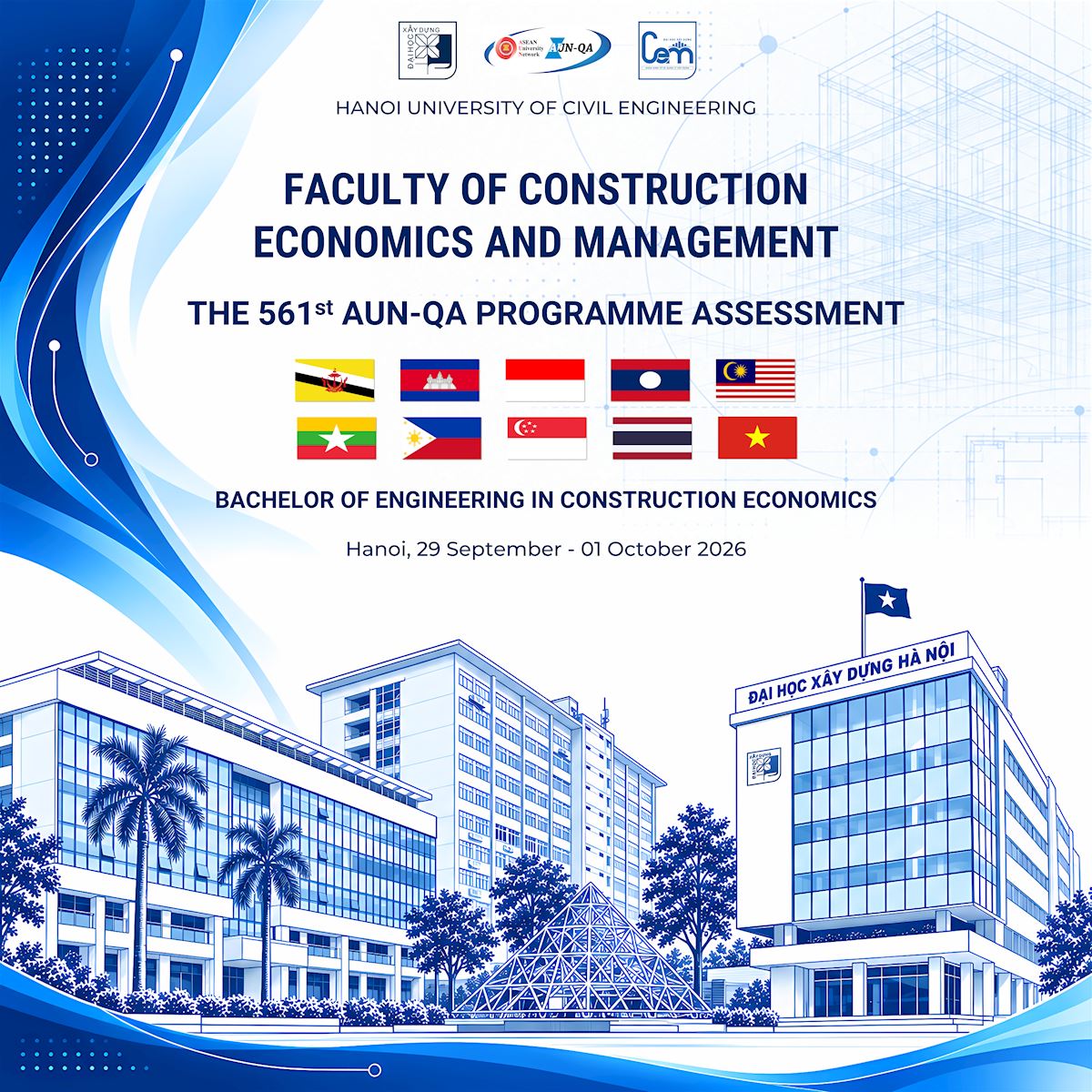


 30/09/2026
 ![[CONSTRUCTION ECONOMICS ENGINEERING PROGRAMME – OVER 60 YEARS OF DEVELOPMENT, WORKING TOWARDS AUN-QA QUALITY STANDARDS]](https://kinhtexaydung-en.huce.edu.vn/images57/Images/CEM/Picture1(1).png)