As a major within the field of Construction Management, Construction Investment Audit involves collecting information about investment projects in order to cross-check and compare, ensuring investments are purposeful, effective, and minimize or eliminate waste, while ensuring compliance, accuracy, correctness, and suitability throughout the project investment process.
With many years of experience in leading the training of majors in Construction Economics and Construction Management, the Faculty of Economics and Construction Management at Hanoi University of Civil Engineering is currently the first institution to establish the Construction Investment Audit major to meet the country’s practical needs.
Listening to the “voice” of businesses to launch the major
In an interview with the Vietnam Electronic Magazine, Associate Professor Dr. Nguyễn Quốc Toản – Deputy Head of the Faculty of Economics and Construction Management at Hanoi University of Civil Engineering – stated:
Currently, according to Circular No. 09/2022/TT-BGDĐT of the Ministry of Education and Training, there is only a general auditing training program, which primarily focuses on corporate auditing and budget auditing. At the undergraduate level, no institution offers training for human resources specifically in construction investment auditing.
Meanwhile, compared to many developed countries, internal auditing activities in Vietnam are still at an early stage. However, with the trend of integration and the ongoing improvement of the legal framework for internal auditing, the demand for human resources in this field in Vietnam is very high and is forecasted to grow strongly in the future.
Those who are currently working in construction investment auditing are either individuals trained in general auditing who have then learned about construction, or individuals trained in construction who have then learned about auditing in order to practice. Therefore, training human resources specifically for construction investment auditing is highly necessary.
With its specific characteristics, the Construction Investment Audit major requires experts performing this role to have a deep understanding of construction techniques, investment and construction law, and the various professional tasks within construction investment, such as: reading blueprints, understanding architectural structures, building systems, construction technology, construction norms and pricing, analyzing and evaluating investment projects, and auditing and settling construction investment capital, among others.
These areas of knowledge are typically not offered by institutions focusing on finance, economics, or commerce, as they lack sufficient technical expertise. In reality, although tens of thousands of students graduate each year in accounting and auditing in Vietnam, they are often not immediately ready to meet the demands of businesses. This reflects a current shortage in the quantity of professionals specializing in construction investment auditing in the country.
Therefore, establishing the Construction Investment Audit major at this stage is essential to train and supply high-quality professionals to auditing companies, government agencies, corporations, and state-owned enterprises, supporting the economic and social development of the nation.
Audit results are used by investors, construction companies, and state management agencies to provide reliable information for timely handling of emerging issues, correcting irregularities in disbursement, allocation, and use of investment capital. The findings in audit reports serve as a basis for assessing whether projects comply with investment and construction management laws and regulations, while also providing recommendations to relevant authorities for improving policies, mechanisms, and legislation.
To carry out these tasks, Vietnam needs a large number of graduates and engineers formally trained in Construction Investment Audit. Through professional workshops and exchanges with businesses, Hanoi University of Civil Engineering has observed that today’s labor market requires construction investment auditors to possess legal knowledge, professional certification, practical skills, the ability to read and understand design drawings, and hands-on experience in calculating quantities and estimating construction investment costs.
For these reasons, “the Department of Economics and Construction Management proposed the establishment of this major, and it was approved and strongly supported by the university leadership, faculty, and staff. Enterprises also participated in consulting and providing feedback on the curriculum, ensuring that graduates can immediately adapt to professional work.
Essentially, the training mechanism of universities today is similar to a business. The output of the university is the input “product” transferred to businesses. We must not only train what universities have, but also what society needs. Therefore, instructors must continuously update the curriculum to meet societal demands,” emphasized Associate Professor Nguyễn Quốc Toản.
According to Associate Professor, Ph.D. Nguyễn Quốc Toản, after graduation, students majoring in Construction Investment Audit will be qualified to work in positions such as: officers or specialists in developing economic-technical norms, preparing construction estimates, preparing bidding documents for construction and installation projects, managing construction sites in enterprises, project management boards, or research institutes; consultants for project preparation and analysis, cost verification, and providing consulting services for bidding participation; specialists reviewing loan dossiers in commercial banks or insurance companies; internal auditors in enterprises, investors, and project management boards across all economic sectors in accordance with the law; as well as researchers and lecturers at educational and training institutions.
In addition, graduates can work as officers or specialists in departments responsible for project preparation, analysis, and appraisal; developing construction norms, pricing, and contracts (such as in credit institutions, banks; Infrastructure Economics Departments, Urban Management Offices, Project Management Boards, Land and Construction Departments, Land Development Centers, etc.) at provincial, district, or commune levels.
With professional certification, graduates in Construction Investment Audit can also establish their own auditing service companies to pursue independent business opportunities.
Depending on individual capabilities and work performance, graduates’ incomes will vary. In some auditing firms, professionals in this field earn an average base salary of around 7–8 million VND per month, plus business-related income (based on a percentage of bonuses from handling construction investment project tasks). Notably, auditors who quickly adapt to work requirements and meet company expectations can achieve a monthly income of nearly 20 million VND within one year after graduation.
Discussing this issue, Mr. Phạm Đặng Giang Quân, who has 10 years of experience as a construction investment auditor at ASC Auditing Co., Ltd., stated that career opportunities in this field are very promising, especially as investor organizations increasingly require personnel with professional auditor certifications. Generally, the starting salary for graduates is around 7 million VND per month, with significant opportunities for career advancement depending on each individual’s professional competence.
Leveraging strengths in economics, management, and engineering education
Regarding the training orientation for this major, Associate Professor, Ph.D. Nguyễn Quốc Toản shared:
Firstly, for training materials, the Faculty of Economics and Construction Management, together with the University Library of Hanoi University of Civil Engineering, has carefully compiled, reviewed, and developed textbooks and reference materials—both domestic and international—for each subject to integrate into the training curriculum.
Secondly, the Faculty has collaborated with experts from independent auditing firms and the State Audit Office to develop the Construction Investment Audit curriculum, ensuring that it matches the capabilities of staff while approaching international quality standards.
Thirdly, during the research and preparation process, the University frequently interacts with businesses to ensure students gain a balanced education combining theoretical knowledge with practical skills. Companies provide documentation from various construction investment projects, which students can use as input data for coursework and assignments.
The Faculty has conducted surveys of market demand and invited auditing firms such as ASCO Auditing & Valuation Co., IFA Auditing & Consulting Co., Vinaconex Group, as well as government agencies, the Vietnam Construction Economics Association, and the Construction Economics Department of the Ministry of Construction, to contribute opinions and advice to the training program.
Fourthly, the Construction Investment Audit major applies numerous digital transformation tools and project management software such as BIM, Microsoft Project, and Crystal Ball to manage progress, assess risks, and analyze project finances. These tools also serve as valuable learning resources to help students excel in this field.
Notably, with over 60 years of training experience and 55 years since its establishment, the Faculty of Economics and Construction Management at Hanoi University of Civil Engineering is among the faculties with the largest number of undergraduate, graduate, and doctoral students in the university. Its development is closely tied to the growth of the country’s construction industry.
Therefore, the Faculty’s strength lies in its ability to combine auditing expertise with comprehensive knowledge of management processes, current laws, and investment procedures in technology and engineering. This helps fill the gaps for students who have a general background in accounting or auditing but lack in-depth knowledge of construction.
Currently, the Faculty’s teaching staff includes 2 People’s Teachers, 3 Distinguished Teachers, 3 Professors, 8 Associate Professors, 1 Doctor of Science, 29 Ph.D. holders, 22 senior lecturers, and 29 Masters. Many faculty members have studied abroad, possess extensive teaching experience, and hold high professional credibility in both construction and finance sectors, providing students with a solid foundational knowledge for the major.
It is reported that ASCO Auditing & Valuation Co., Ltd. annually accepts about 5–10 students from Hanoi University of Civil Engineering for internships. According to Mr. Đào Thanh Tú, students studying auditing and construction at universities nationwide generally have a solid basic knowledge foundation. However, their practical skills and readiness to adapt to the workplace are still limited, revealing a certain “gap” between academic training and industry requirements.
Therefore, students should be encouraged to engage more in practical courses, increase hands-on experience, extend internships to a minimum of 3 months, and gradually familiarize themselves with the professional environment starting as early as the third year.
For Mr. Lưu Anh Sơn, to improve the quality of education and align students’ competencies with expected learning outcomes, training institutions should design curricula that integrate both finance and construction engineering, covering not only professional expertise but also knowledge of relevant legal documents, domestic and international auditing standards, and professional ethics.
Regarding the training orientation, Associate Professor Dr. Nguyễn Quốc Toản stated that the approximately five-month internship period will be integrated with students’ graduation projects, allowing them to “practice while summarizing.” If students demonstrate strong capabilities during their internships, organizations and enterprises may “recruit and retain” talented individuals immediately upon graduation.
Currently, with the challenges posed by rapidly evolving science, technology, and engineering—particularly digital transformation in the construction industry and across all sectors—faculty must continuously update their knowledge and teaching methods to stay aligned with market trends. This requires the university to invest carefully in human resources, facilities, knowledge resources, and capital.
Giving advice to high school and university students aspiring to pursue the Construction Investment Audit major, Associate Professor Nguyễn Quốc Toản shared:
“Students need to objectively evaluate their own abilities, interests, and aspirations to select and register fora suitable major. Most importantly, they must continually strive to improve, focus on studying, and build a solid knowledge foundation in their field.
At the same time, students should actively participate in extracurricular activities to develop teamwork skills, collaborative abilities, and a sense of social responsibility. Moreover, proficiency in foreign languages and computer literacy is essential in the era of Industry 4.0 and current global integration trends.”
According to Associate Professor Dr. Nguyễn Quốc Toản, Hanoi University of Civil Engineering maintains and develops international cooperation with nearly 80 universities and organizations from over 40 countries, including France, Belgium, the United Kingdom, the Netherlands, Germany, Russia, Italy, Sweden, the United States, Canada, Australia, Japan, China, South Korea, Taiwan, Thailand, and others, to enhance the university’s international academic reputation.
The university is a leading research institution in Vietnam in the fields of construction, urban planning, and architecture. Over the past five years, the university has conducted 672 internal and key internal projects, 136 Ministry-level or equivalent projects, 6 national-level projects, 6 scientific research tasks, and 17 state management tasks related to environmental protection, along with numerous collaborative projects with international research and educational institutions. The university also hosts many international scientific conferences on construction, environmental management, urban planning, and architecture, publishing proceedings included in WoS and SCOPUS databases.
Lưu Diễm
(Nguồn: https://giaoduc.net.vn/mo-chuyen-nganh-kiem-toan-dau-tu-xay-dung-dau-tien-cua-ca-nuoc-dh-neu-ly-do-post244458.gd)

 /
/



 30/09/2026
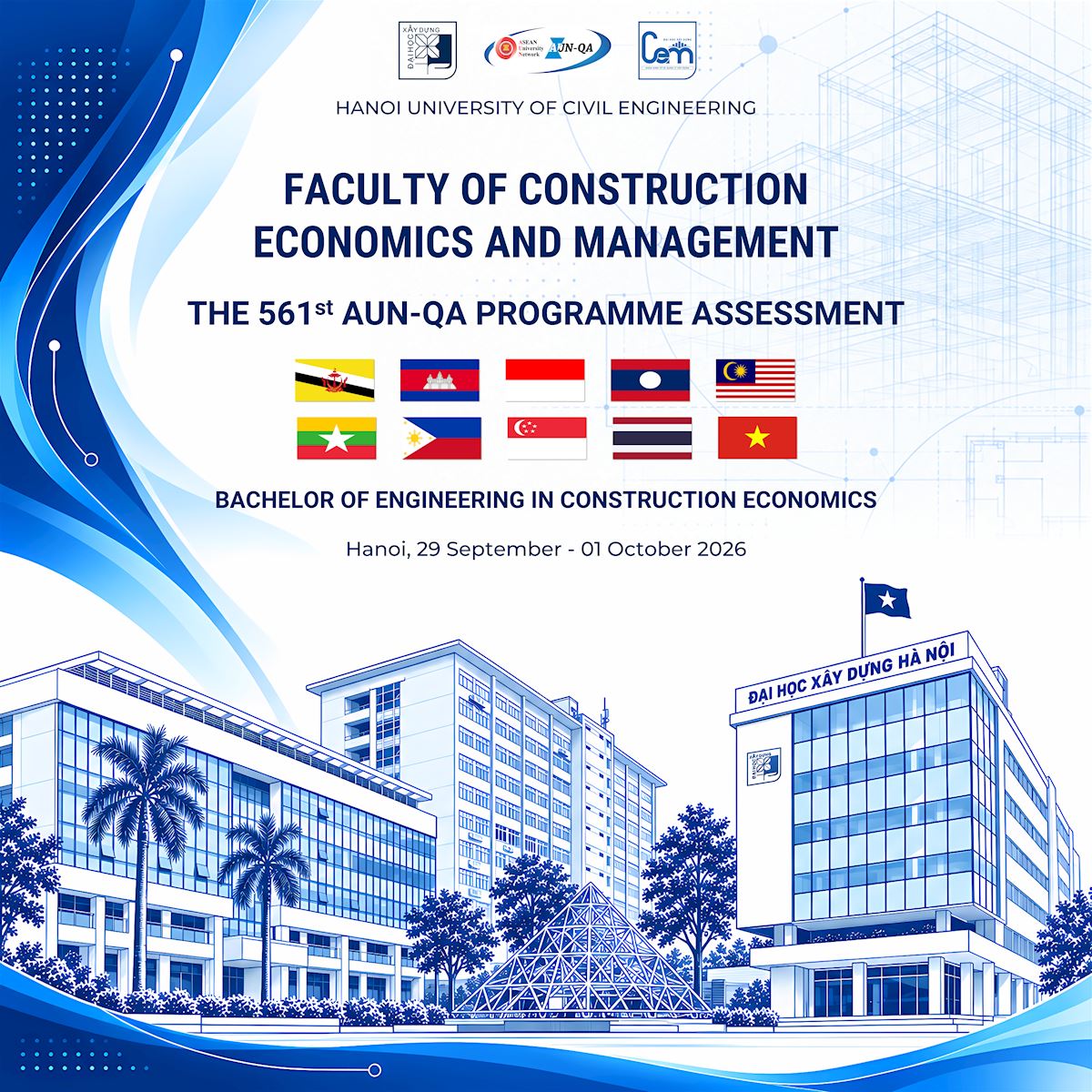
 ![[CONSTRUCTION ECONOMICS ENGINEERING PROGRAMME – OVER 60 YEARS OF DEVELOPMENT, WORKING TOWARDS AUN-QA QUALITY STANDARDS]](https://kinhtexaydung-en.huce.edu.vn/images57/Images/CEM/Picture1(1).png)