Over more than 30 years of renovation and development, Vietnam’s urban system has undergone remarkable transformation. The number of urban areas has increased from 629 in 1999 to 862 by the end of 2020, and the urbanization rate is projected to reach 45% by 2025.
The urban sector has truly become a driving force and a key engine for socio-economic development at both local and national levels, contributing around 70% of the country’s GDP and accounting for a dominant share of budget revenue, exports, and industrial production.
Furthermore, the development of urban infrastructure systems that meet the needs of production, business activities, and social welfare services has significantly contributed to Vietnam’s effective, deep, and extensive integration into regional and global economic forums and communities.
New urban areas in Vietnam have been developing at a breathtaking pace.
With such rapid growth, Vietnamese cities have been and are continuing to face fundamental challenges associated with the process of urbanization, including:
(1) Lack of diversity in urban growth models; growth remains unsustainable and heavily dependent on resource exploitation;
(2) Limited long-term vision and reserve capacity; rapid expansion of urban areas has led to inefficient land use;
(3) Inadequate infrastructure systems that fail to fully meet the needs of residents and economic activities;
(4) Urban management capacity and mindset lagging behind the pace of urbanization, resulting in increased traffic congestion and environmental pollution;
(5) Insufficient and underqualified urban management personnel, along with inefficient allocation of resources for urban development and construction investment in many localities.
At present, the quality of bachelor’s and engineering programs offered by universities in Vietnam remains uneven, particularly due to their narrow, single-discipline training approaches. There is still no institution that provides comprehensive and in-depth training in urban management integrated with urban economic management, construction management, and urban infrastructure development aligned with contemporary global trends.
With over 20 years of experience in training professionals in Urban Economics and Management (since 2001), the Faculty of Economics and Construction Management, National University of Civil Engineering, has been highly recognized by society for its pioneering creativity in developing a modern, integrated training program that keeps pace with global directions and practical needs.
The Faculty of Economics and Construction Management and the National University of Civil Engineering possess the necessary resources — both in terms of qualified academic staff and modern infrastructure — to provide training in this specialized field.
The program aims to produce engineers and bachelors who not only have a strong foundation in technical and economic knowledge but also possess management capabilities, particularly in construction and urban development. These graduates will be well-equipped to meet the urgent needs of society, address the rapid pace of urbanization, and contribute effectively to national economic growth in the context of the Fourth Industrial Revolution (Industry 4.0).
 Smart City Management

The Urban Economics and Management major offers two flexible training programs for students to choose from:
-
Bachelor’s Program (Bachelor’s Degree in Urban Economics and Management) – a shortened program lasting 3.5 to 4 years, equivalent to 130 credits;
-
Engineering Program (Engineer’s Degree in Urban Economics and Management, equivalent to a Master’s level) – a 5 to 5.5-year program. Students who complete the bachelor’s program can continue their studies for an additional 1 to 1.5 years (equivalent to 50 credits) to earn the Engineer’s Degree.
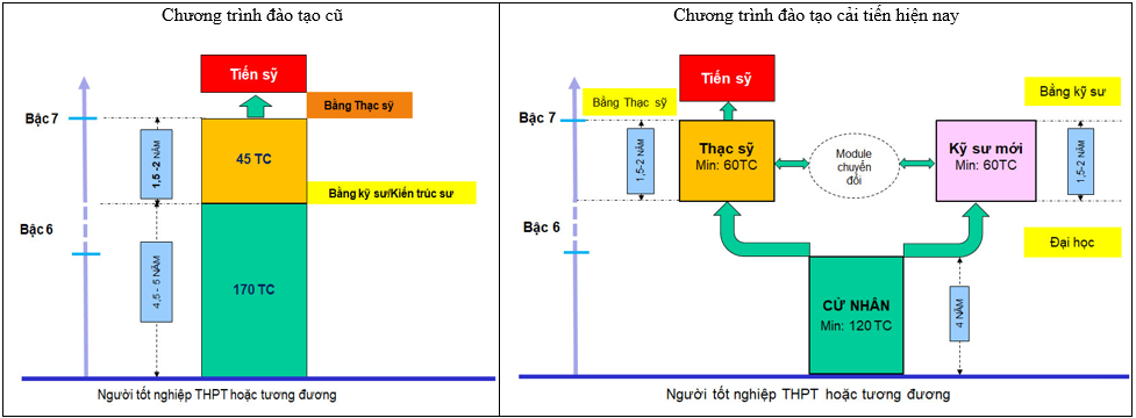
Comparison Between the Previous and the Newly Improved Training Programs
According to the new curriculum framework for the Bachelor’s level, compared to the Engineer’s level, students in this program will have a shorter study duration and a reduced number of technical construction courses that are considered more challenging. Instead, the program focuses on subjects that are directly applicable to professional practice.
The knowledge blocks taught in the Bachelor’s program include:
-
General Knowledge Block
Courses such as Advanced Mathematics, Basic English, Politics, and Fundamentals of Information Technology.
-
Fundamental and Interdisciplinary Knowledge Block
Courses such as Microeconomics, Fundamentals of Management Science, Descriptive Geometry – Technical Drawing, Structural Mechanics, Strength of Materials, Soil Mechanics, Reinforced Concrete Structures, Construction Techniques, and Building Services Systems.
-
Specialized Knowledge Block
Covering areas in Construction Economics, Construction Management, and Urban Management, including:
-
Preparation and evaluation of construction project feasibility studies;
-
Preparation, verification, and appraisal of cost estimates and settlement reports for urban construction works;
-
Preparation and evaluation of bidding documents and tenders in urban construction;
-
Strategic business planning;
-
Development of technical and economic standards for urban services;
-
Cost estimation and cost management in urban construction;
-
Site organization and supervision of urban construction works;
-
Urban management, among others.
This improved program provides students with a more practical, application-oriented education, aligning with current industry demands and the rapid pace of urban development.

In addition to the traditional knowledge and skills of a construction economics engineer, students majoring in Urban Economics and Management are also equipped with strong competencies in urban management and legal frameworks—areas that are not typically covered in other economics–engineering programs.
These added capabilities enable graduates not only to perform well in technical and professional tasks but also to take on roles requiring coordination, management, communication, leadership, and strategic connection.
This can be seen as a perfect enhancement to the traditional image of construction engineers—who were once primarily associated with concrete, steel, bricks, cost estimation, quantity take-offs, and documentation—by developing a new generation of professionals who combine technical expertise with managerial and leadership skills suited to modern urban development challenges.

Moreover, the training program provides students with opportunities for field visits and practical internships at construction sites, enterprises in the construction sector, and agencies or units involved in urban management.
These experiences allow students to engage directly with real-world situations, gain hands-on experience, and develop soft skills, ensuring they acquire the comprehensive knowledge and abilities needed to perform effectively in practical work environments.

The Faculty organizes field visits and practical internships for students at construction sites, construction enterprises, and agencies or units involved in urban management.
Career opportunities for graduates of the Urban Economics and Management major are extensive, including positions such as:
-
Urban construction and public administration management;
-
Development of norms and unit costs for urban services and construction works;
-
Preparation and analysis of investment projects for urban technical systems and infrastructure;
-
Management of urban infrastructure investment projects, including supervision and execution of urban construction works, among others.
Graduates are well-prepared to meet the diverse and growing demands of urban development and management.
Graduates of this major can also work in positions such as quantity surveying and construction cost estimation, construction bidding, project preparation and evaluation, and construction project management, among others.
According to surveys conducted by the program, 90.5% of graduates in Urban Economics and Management secure employment after graduation, with an average monthly income of 8–15 million VND. The remaining graduates mostly pursue further studies at the National University of Civil Engineering or at international training institutions.

Graduation Performance
Admission Information for the Urban Economics & Management Major – 2021
-
Intake quota: 100 students
-
High School Graduation Exam subject combinations for admission 2021:
-
Combination 1 – A00: Math, Physics, Chemistry
-
Combination 2 – A01: Math, Physics, English
-
Combination 3 – D07: Math, Chemistry, English
-
Program code: XDA24
-
Admission score 2020: 20 points
For detailed information, please contact:
Faculty of Economics and Construction Management – National University of Civil Engineering (NUCE)
Msc. Ngô Văn Yên
Faculty of Economics and Construction Management, National University of Civil Engineering


 30/09/2026
 ![[CONSTRUCTION ECONOMICS ENGINEERING PROGRAMME – OVER 60 YEARS OF DEVELOPMENT, WORKING TOWARDS AUN-QA QUALITY STANDARDS]](https://kinhtexaydung-en.huce.edu.vn/images57/Images/CEM/Picture1(1).png)