Real estate is considered an “ecosystem” of the economy as it creates demand and drives the development of hundreds of other industries. According to experts, the trend of real estate expansion and development is expected to continue at least until 2025, when Vietnam will have basically completed industrialization and entered sustainable, in-depth development.
The labor market shows that the real estate sector still faces shortages and weaknesses. There is a shortage because there are not enough human resources to meet the sector’s expansion and development needs. There is a weakness because many civil engineers graduate without sufficient knowledge of economics, management, and investment, while business professionals often lack technical knowledge, construction technology, and the ability to analyze and evaluate real estate investment options.
To meet the urgent demand for high-quality human resources, the National University of Civil Engineering (NUCE) annually admits 50 students into the Real Estate Economics and Management program from three subject combinations: A00 (Math – Physics – Chemistry), A01 (Math – Physics – English), and D07 (Math – Chemistry – English). The program aims to train engineers who are proficient in analyzing and evaluating real estate investment options, managing and operating real estate projects, and marketing to both domestic and international clients. Recent admission scores ranged from 14.75 to 17.00 points.
Duration: The program is credit-based with a duration of 4.5 years. Students may shorten the study period if they enroll in extra courses.
Degree awarded: Bachelor of Engineering in Construction Management.
a. Knowledge areas covered:
Construction engineering knowledge
Construction management knowledge
Economics and finance knowledge
Land law and project legal knowledge
Environmental knowledge
b. Skills acquired after graduation:
Valuation of specific real estate properties
Building management and operations
Research on legal documents related to real estate and construction
Real estate brokerage and trading floor organization
Project analysis and evaluation for real estate investments
Appraisal of specific real estate projects
a. Scholarships:
In addition to the university’s regular academic encouragement scholarships, students may receive department-sponsored scholarships for overcoming difficulties and achieving excellent academic performance, such as:
Vietinbank Scholarship (VND 3 million)
FLC Scholarship
Le Mong Dao Scholarship (VND 5 million)
Do Quoc Sam Scholarship (VND 5 million)
CSC Scholarship (up to USD 5,000 for the highest, 12 awards at VND 5 million each)
Other scholarships are also sponsored by alumni of the Faculty of Economics and Construction Management.
b. Academic support:
From enrollment to graduation, students are provided with excellent learning facilities and encouraged to develop soft skills, participate in scientific research, and engage in extracurricular activities such as joining the Real Estate Economics and Management Club, receiving career guidance from the first year, and participating in site visits and internships to combine theoretical knowledge with practical experience.
Graduates of Real Estate Economics and Management are highly sought after by employers. 100% of students find employment within three months after graduation, with an average income of 8–12 million VND per month in the first year.
Graduates can work in domestic and international organizations, including:
Construction companies and real estate investment businesses
Government agencies managing real estate
Financial institutions, banks, investment funds, and insurance companies
Asset appraisal and auction companies
Real estate trading floors
a. Postgraduate study:
Graduates can pursue higher education programs domestically or internationally without the need to retake any courses. The flexible training format suits various working conditions of students.
b. Dual-degree programs (second degree):
Students interested in deeper training in construction engineering or other disciplines may enroll in a dual-degree program starting from the second year (if the first-year GPA is at least “Good”), or after graduation, with a study duration of about 3–4 semesters.
Address: Room 319A1, National University of Civil Engineering, 55 Giai Phong Street, Hai Ba Trung, Hanoi, Vietnam
Phone: (024) 3869 1829 | Hotline: 0969723886
Email: bm.ktqlbds@nuce.edu.vn

 /
/



 30/09/2026
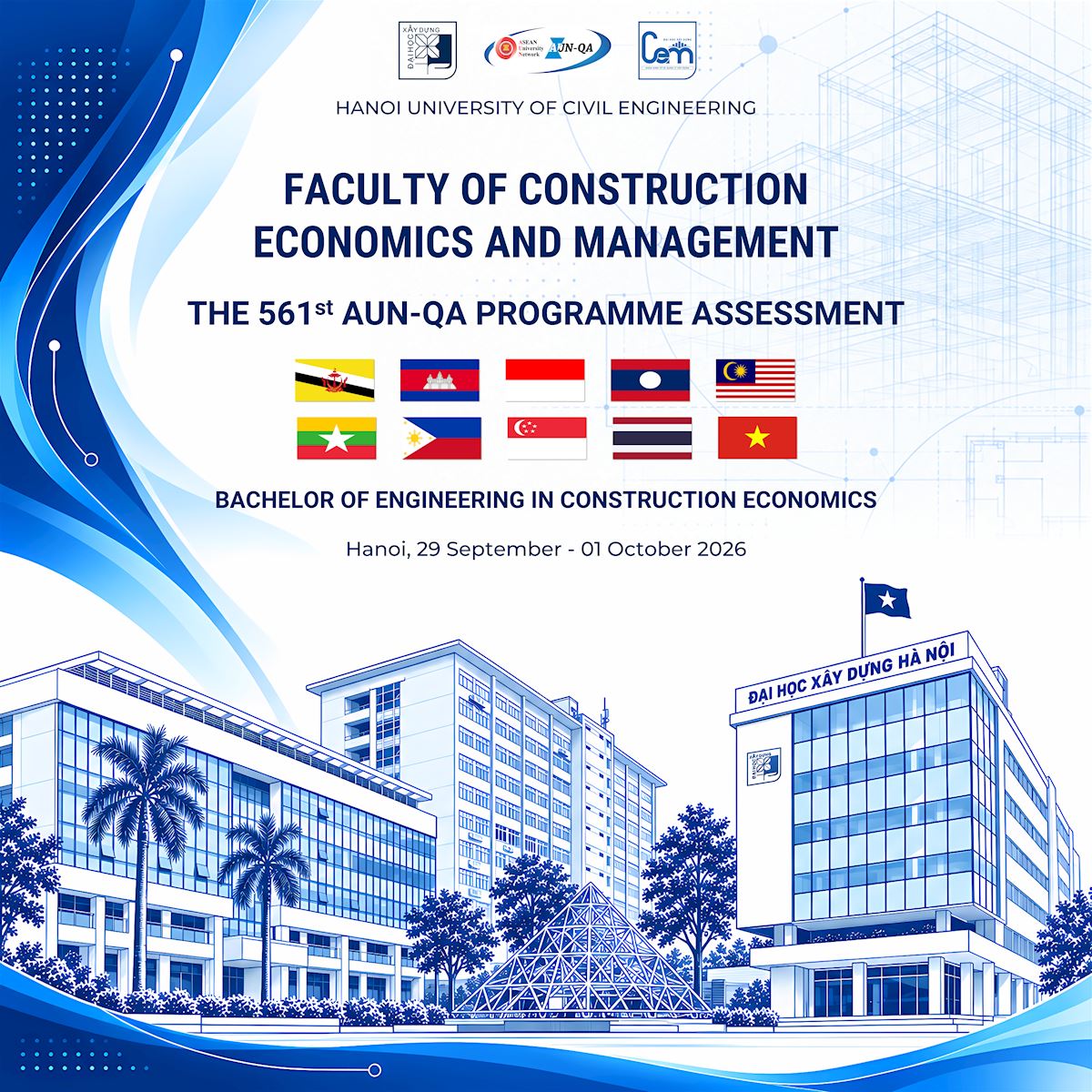
 ![[CONSTRUCTION ECONOMICS ENGINEERING PROGRAMME – OVER 60 YEARS OF DEVELOPMENT, WORKING TOWARDS AUN-QA QUALITY STANDARDS]](https://kinhtexaydung-en.huce.edu.vn/images57/Images/CEM/Picture1(1).png)