Accompanying economic growth is the development of social infrastructure systems, marked by an increasing number of construction projects that are larger in scale, more diverse in architectural types, more complex in technical aspects, and more versatile in functionality.
This trend creates rigorous demands for the ability to organize, manage, and coordinate effectively among stakeholders involved in the construction process in order to achieve optimal efficiency in cost, time, and project quality.
In recent years, Vietnam’s infrastructure system has experienced significant transformation, reshaping the appearance of major cities nationwide and giving the country a new, dynamic, and modern outlook. However, there remains a shortage of skilled professionals—qualified managers and analysts in the construction sector—capable of meeting the growing demand for national development, especially in the field of construction investment project analysis and evaluation.
To enhance the efficiency of construction investment, it is essential to strengthen project analysis and evaluation practices, and to apply appropriate assessment and comparison methods in selecting the most effective technical and investment alternatives. These processes play a crucial role in decision-making and in determining the best investment options.
The field of Construction Investment Project Analysis and Evaluation helps students develop essential skills in project investment, project management, leadership, organization, and related managerial activities. Furthermore, students are equipped with a strong foundation in economics, emphasizing the ability to address real-world challenges in construction investment and to optimize the efficiency of construction projects.
The study of financial needs and the assurance of funding resources are critical for the effective implementation of construction investment projects. Through specialized analytical and financial skills, business owners can determine the project’s investment scale, capital structure, and appropriate sources of financing.
From the investor’s accounting perspective, financial analysis must assess the financial condition, performance, and effectiveness of the project. This includes calculating costs and evaluating the benefits derived from the project’s operations.
Based on the research and analytical results, investors can decide whether or not to proceed with the proposed project.
Through these activities, we determine how to assess the financial efficiency of a construction investment project and generate returns for investors.
A key question arises: Is the construction investment project feasible?
To answer this, enterprises must first consider the project’s objectives, financial capacity, and the potential maximum return on investment.
The next step involves executing the project’s financial analysis process, which aims to address the following:
Determining total investment costs, funding allocation, and capital structure.
Carefully calculating actual revenues, expenditures, and profits.
The total investment cost of a project includes all expenses required to ensure normal project operation according to established objectives—such as land clearance and compensation, construction costs, equipment costs, project management costs, consulting fees, miscellaneous costs, and contingency expenses.
These are costs incurred before the project is officially implemented, covering necessary preliminary expenses to ensure project activities proceed according to plan.
This includes expenditures for tangible and intangible fixed assets.
Tangible assets: costs of purchasing machinery, equipment, and construction-related assets acquired or transferred to the project.
Intangible assets: non-physical assets with measurable value related to the business cycle.
This also includes working capital used for financial instruments such as cash reserves, inventories, receivables, and payables.
By identifying a project’s costs and benefits, its profitability can be accurately assessed—an essential task in financial project analysis.
(i) The key indicator for assessing benefits and costs is the time value of money.
(ii) Both investment costs and project returns are expressed through monetary value, which varies over time in several ways:
The same amount of money can purchase different quantities of assets at different points in time.
The same amount of money may yield better results in one activity than another, due to opportunity costs.
Every project faces potential risks. However, through detailed financial analysis, enterprises can assess a project’s financial feasibility and future viability. These analyses provide valuable insights for attracting investment and capital funding.
Graduates specializing in Construction Investment Project Analysis and Evaluation can pursue a wide range of careers, including:
Construction management positions in state agencies overseeing construction investment, from central ministries such as the Ministry of Construction, Ministry of Planning and Investment, Ministry of Finance, Ministry of Transport, and Ministry of Agriculture and Rural Development, to local departments such as Departments of Construction, Architecture and Planning, Transport, Planning and Investment, Finance, and Agriculture.
Research positions at institutes specializing in construction economics and management.
Consultancy roles in project preparation, investment efficiency analysis, and project evaluation within corporations, enterprises, and investment groups in the construction sector.
Project appraisal roles in commercial banks, insurance companies, investment funds, and financial institutions.
Project management positions in project management units and investor organizations.
Academic and teaching positions at universities, colleges, and research institutes.
Entrepreneurship opportunities through startup projects in the field of construction investment and management.

 /
/



 30/09/2026
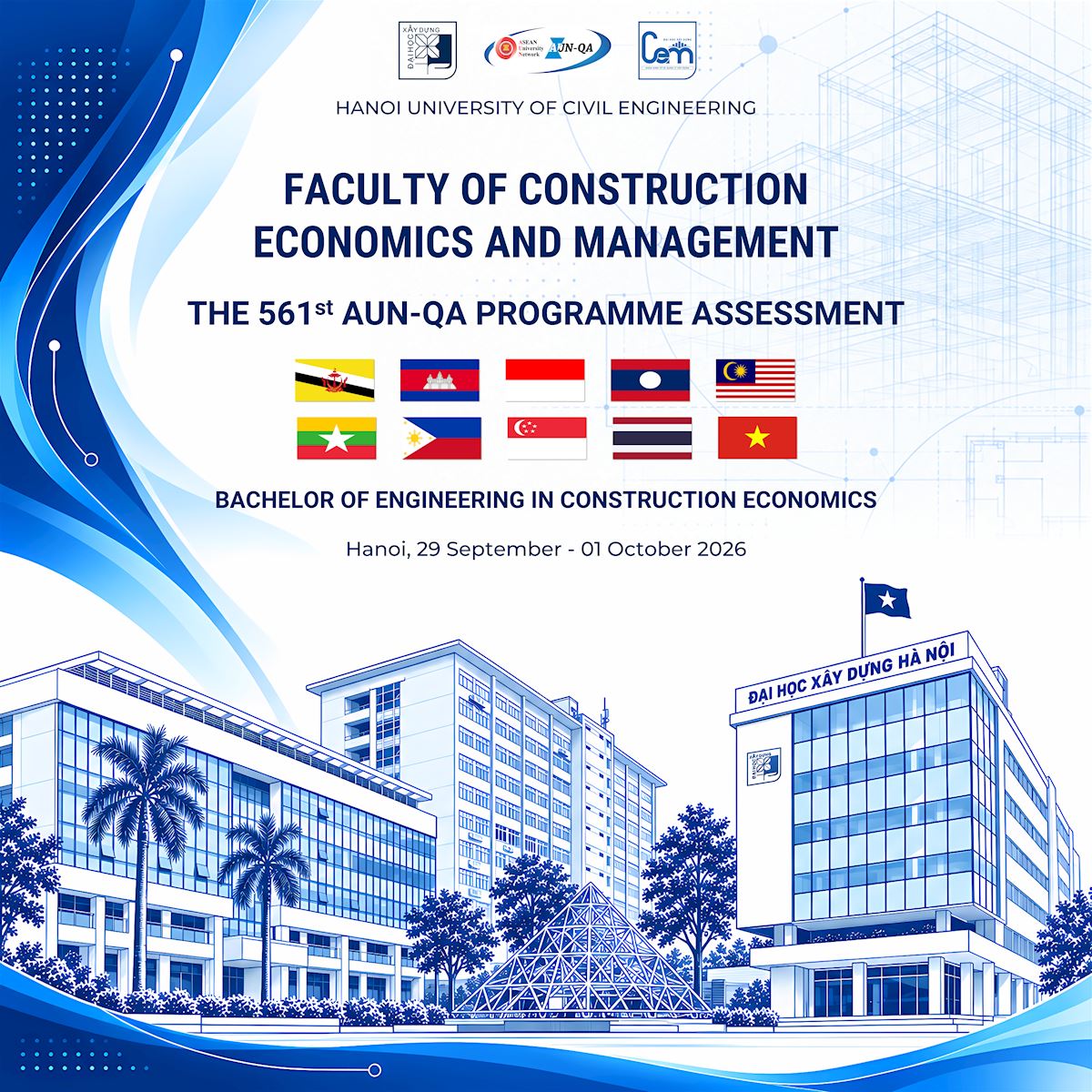
 ![[CONSTRUCTION ECONOMICS ENGINEERING PROGRAMME – OVER 60 YEARS OF DEVELOPMENT, WORKING TOWARDS AUN-QA QUALITY STANDARDS]](https://kinhtexaydung-en.huce.edu.vn/images57/Images/CEM/Picture1(1).png)